
SmartPave is a residential grade of permeable paving use to stablise decorative...
Home Case Studies Creating a Stable Garden Path on a Sloping Landscape
Creating a Stable Garden Path on a Sloping Landscape
Facebook
Twitter
LinkedIn
Pinterest
Reddit
WhatsApp
Creating a Stable Garden Path on a Sloping Landscape
The Problem: Garden Paths on Slopes Often Wash Away
Garden paths built on slopes can look stable at first, but over time rain and gravity begin to take their toll. Gravel shifts, edges soften, and material slowly migrates downhill. Eventually the path becomes uneven and difficult to walk on.
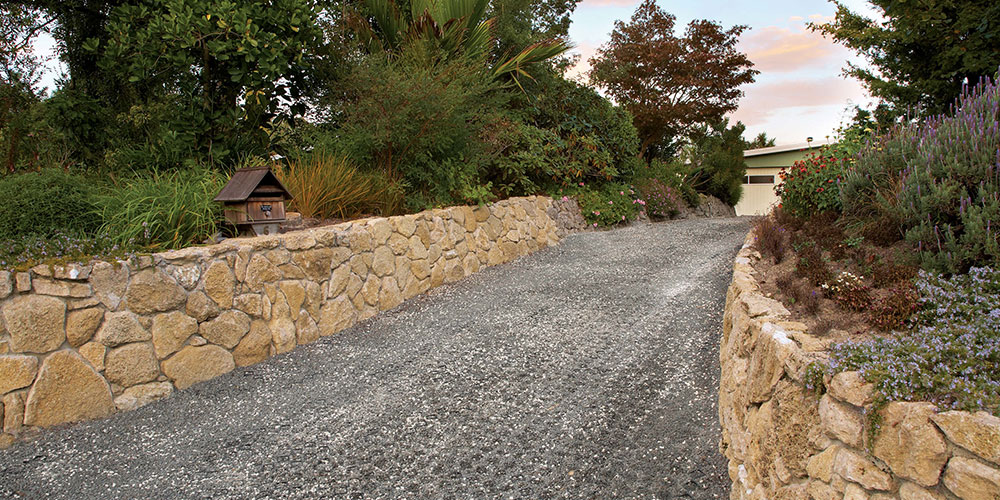
That was the challenge in this project. The path required sits on a steep slope to provide access to services beneath the house. The goal was to stabilise the surface while still allowing water to drain naturally through the ground.
The Solution: A Permeable Structure Beneath the Path
To solve the problem, a Natural Paving grid system, similar to SmartPave, was installed beneath the stone aggregate.
From above, the finished path still looks like loose stone. Beneath the surface, however, a honeycomb-style grid creates a structural layer that locks the aggregate into place. This prevents the material from gradually moving downhill over time.
Because the system is permeable, rainwater can still pass through the surface and return to the soil below rather than running off and carrying material with it.
This combination of stability and drainage is what makes permeable paving particularly effective for paths built on sloping landscapes.
The Installation: Laying the Natural Paving System
Installation begins with preparing a stable base. In this project, the path was first marked out along the natural walking line, with a retaining wall added on the downhill side to support the slope. A compacted layer of crushed rock (around 50 mm deep) was then installed to create a firm foundation.
The panels were laid directly over this base, interlocking to form a continuous structural grid beneath the path. Once in place, the cells were filled with crushed river stone and compacted, so the aggregate settled evenly into the grid. The result is a natural-looking path that remains stable underfoot while still allowing water to drain through the surface.
The Result: A Stable, Permeable Garden Path
From the surface, the finished path looks like a simple gravel walkway. What makes the difference is the structure underneath.
The Natural Paving grid stabilises the aggregate, so it remains in place even on slopes, while still allowing water to pass through the surface.
The result is a garden path that:
• Stays stable underfoot
• Allows water to drain naturally
• Blends into the surrounding landscape
• Requires minimal maintenance over time
Rather than turning the area into a sealed hard surface, the path remains permeable and behaves more like natural ground.
FAQs
Can SmartPave be used on sloped garden paths?
Yes. The grid structure stabilises the aggregate and helps prevent material from migrating downhill, making it ideal for sloping landscapes.
What material was used for the path surface?
The project uses crushed river stone, which creates a natural finish while working well with the stabilising grid beneath.
Does permeable paving allow water to drain?
Yes. Both SmartPave and Natural Paving are permeable paving systems that allows water to pass through the surface and return to the soil below.
Watch the Project in Action
Watch the full video to see how the Natural Paving system is installed and how it helps stabilise garden paths on sloping landscapes.
Quick Links

Enhance your driveway, paths and outdoor living spaces with permeable paving giving...